


QA cloakroom is a paradox. It’s the smallest “public” room in most homes—yet it’s the one guests remember. It’s where first impressions get made in the time it takes to wash hands. And because it’s compact, every decision feels louder: the tile line, the tap choice, the mirror height, the radiator placement. There’s nowhere for awkward spacing or sloppy finishes to hide.
Now add a firm budget—£4,000—and the project becomes even more interesting. Not impossible. Not restrictive. Just… demanding. It asks for planning with teeth: smart sequencing, realistic allowances, and trades that communicate.
This post breaks down what a £4,000 cloakroom renovation with Plumb Suite Ltd can include—and how to spend that budget in a way that looks intentional, performs reliably, and feels far more expensive than it is.
What a £4,000 Budget Really Buys: Clarity, Not Chaos
Let’s get honest: a cloakroom renovation isn’t “small” just because the room is small. You still have plumbing stages, tiling, electrics (often), carpentry touch-ups, finishing, and the fussy details that make it feel complete. The difference is that cloakrooms punish indecision. The margin for error is tiny, and the cost of rework can be disproportionate.
Thought-provoking insight: The biggest budget killer isn’t high-end materials—it’s ambiguity. When the scope is fuzzy, the spend becomes slippery.
With Plumb Suite Ltd, a £4,000 cloakroom package focus (as specified) can include:
- 1st fix plumbing and 2nd fix plumbing
- Towel radiator supply/installation
- Ceramic floor-to-wall tiling
- Furniture (vanity)
- Handyman items: mirror and accessories fitting
- Carpenter involvement (as needed for trimming, boxing-in, finishes)
Practical advice:
Accept that “luxury” here comes from execution and cohesion, not just expensive products.
Decide early what’s non-negotiable (e.g., full-height tiling, vanity storage, heated towel rail).
In a cloakroom, tiling isn’t just protection—it’s architecture. It defines the room’s identity.
Matthew Pooley
The Backbone: 1st Fix vs 2nd Fix Plumbing (And Why This Order Matters)
Plumbing is the skeleton. If it’s wrong, the cloakroom becomes an ongoing “project” long after the invoices are paid.
1st fix plumbing is the behind-the-scenes phase:
- Setting pipe runs and waste positions
- Relocating feeds if layouts change
- Preparing for radiator connections and isolation valves
- Ensuring everything is aligned with the planned vanity and toilet positions
2nd fix plumbing is the visible, satisfying phase:
- Installing and connecting sanitaryware
- Fitting taps, wastes, traps
- Final connections and testing
- Finishing for clean presentation (no wobbles, no weeps, no improvisation)
Thought-provoking insight: A cloakroom fails in millimetres. If the waste is off by a little, the vanity fit becomes a compromise—then every next step inherits that compromise.
Practical advice:
Build in serviceability: isolation valves and sensible access reduce future disruption.
Choose the vanity and basin before 1st fix is finalised. Dimensions dictate pipe and waste positioning.
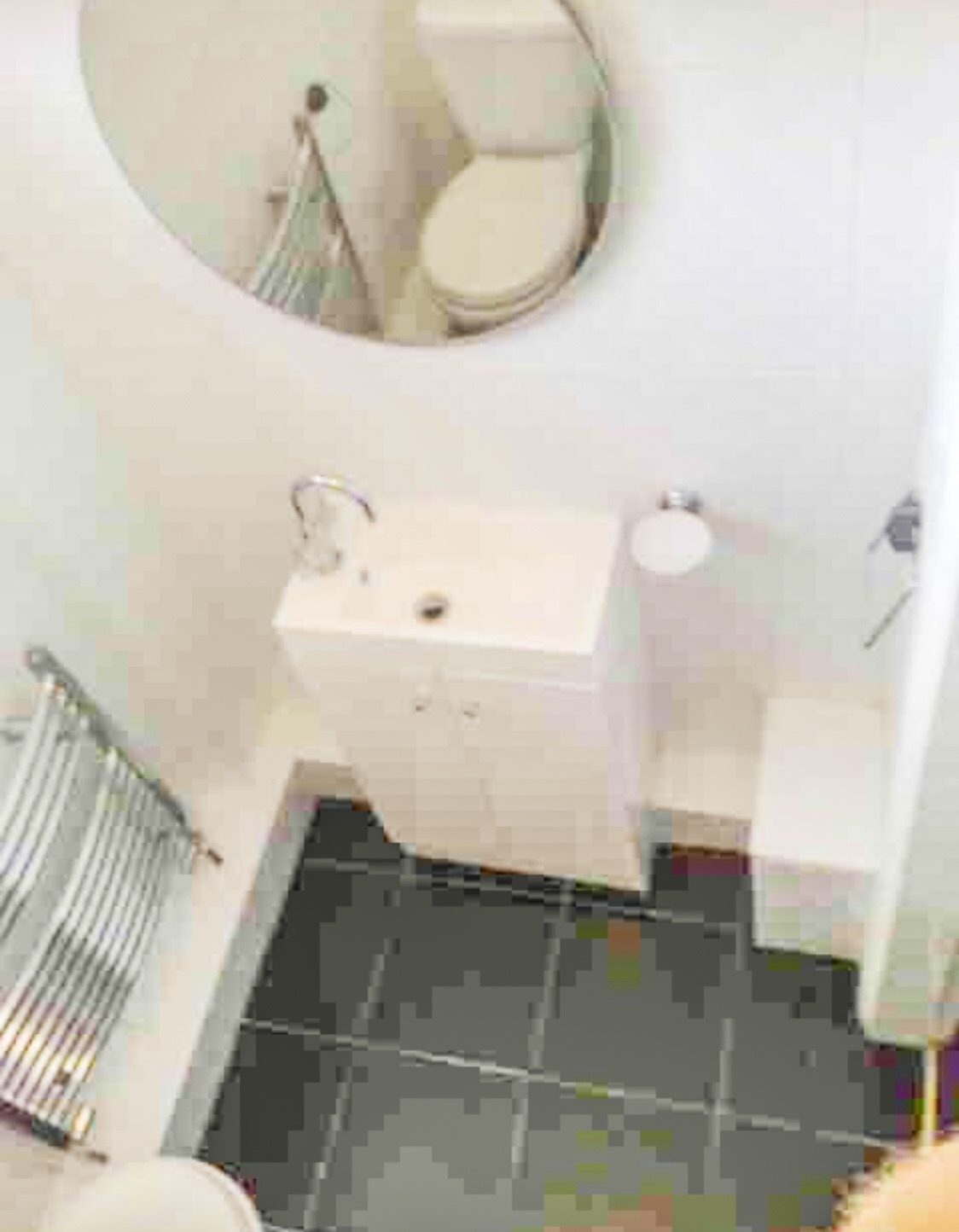
The Heat + Comfort Upgrade: Why a Towel Radiator Is a Cloakroom Power Move
A towel radiator in a cloakroom can feel like an upgrade you didn’t know you needed. It dries hand towels faster, reduces dampness, and makes the room feel “designed,” not just assembled.
Thought-provoking insight: Guests might not comment on a towel radiator—but they’ll feel the comfort of a room that isn’t cold, clammy, or vaguely unfinished.
Practical advice:
Consider finish consistency (chrome, black, brushed brass) with taps, mirror, and accessories for a cohesive look without extra cost.
Place it where towels can hang naturally without brushing walls or blocking movement.
Ensure the size matches the space: too small feels pointless; too big overwhelms.
Floor-to-Wall Ceramic Tiling: Big Visual Payoff, Small Room Advantage
Full-height ceramic tiling is one of the smartest cloakroom “value plays.” In a large bathroom it can be expensive; in a cloakroom it becomes achievable and instantly elevated—clean lines, durability, and that boutique-hotel vibe.
Thought-provoking insight: In a cloakroom, tiling isn’t just protection—it’s architecture. It defines the room’s identity.
Practical advice:
Ask for layout planning: where will cuts land? What do you see first when the door opens? That first sightline matters.
Pick one “hero” tile concept and keep the rest calm. For example:
Bold patterned floor tile + plain wall tile
Plain floor + textured wall tile
Same tile everywhere with a contrasting grout line for subtle drama
Think about grout colour like it’s paint. It can sharpen the look or muddy it.
The Finishing Stack: Vanity, Mirror, Accessories, and Carpentry That Makes It Look Custom
This is where cloakrooms win or lose their “expensive” feel. The room is small, so the finishing touches aren’t just décor—they’re the final proof of care.
Vanity (Furniture)
A vanity adds storage, hides pipework, and makes the whole room feel intentional.
Practical advice:
- Choose a vanity with enough internal clearance for plumbing connections.
- Consider depth: too deep steals standing room; too shallow can look mean.
Handyman Mirror + Accessories
Mirror height, towel hooks, toilet roll holder placement—these are tiny decisions with huge daily impact.
Practical advice:
- Set mirror height for real users (eye line), not “centre of wall.”
- Accessories should be aligned—visually and practically—so the room feels designed, not dotted with hardware.
Carpenter Input
Carpentry is often what stops a cloakroom from looking “renovated” and starts making it look “built.”
Practical advice:
- Allow for boxing-in where needed (neatly), clean trims, crisp edges.
- If the cloakroom has quirks (uneven walls, old skirting), carpentry finishing is what restores calm.
Thought-provoking insight: People notice craftsmanship more in small rooms because their eyes have nowhere else to go.
Conclusion: A £4,000 Cloakroom Can Feel Like a £10,000 One—If the Plan Is Sharp
A cloakroom renovation on a £4,000 budget isn’t about cutting corners; it’s about cutting confusion. When the scope is defined and the sequence is respected—1st fix to 2nd fix plumbing, towel radiator, floor-to-wall ceramic tiling, vanity furniture, mirror and accessories fitting, and carpentry finishing—the result can be striking.
Plumb Suite Ltd’s focus here is simple: do the fundamentals properly, finish with intention, and make every square inch earn its keep. Tiny room, big impact. The kind of project that makes you close the door, turn back, and think: Yes. That’s exactly right.
